2026 Social Security COLA: What to Expect for Your Benefits

Anúncios
The 2026 Social Security Cost-of-Living Adjustment (COLA) is crucial for beneficiaries, reflecting inflation and directly impacting monthly payouts and financial security for retirees and other eligible individuals.
As we look towards the future, understanding The 2026 Social Security Cost-of-Living Adjustment: What to Expect for Your Benefits becomes increasingly vital for millions of Americans. This annual adjustment, often a lifeline for retirees and other beneficiaries, aims to help maintain purchasing power against the rising cost of living. What factors will shape this adjustment, and how might it influence your financial outlook? Let’s delve into the projections and economic realities that could define the 2026 COLA.
Anúncios
Understanding the Social Security COLA Mechanism
The Social Security Cost-of-Living Adjustment (COLA) is an annual increase in benefits intended to offset the impact of inflation. This adjustment is not arbitrary; it is determined by a specific formula tied to economic indicators, primarily the Consumer Price Index. For beneficiaries, the COLA is a critical component of their financial planning, ensuring that their fixed income can keep pace with the evolving economic landscape.
Anúncios
The Social Security Administration (SSA) calculates the COLA based on the Consumer Price Index for Urban Wage Earners and Clerical Workers (CPI-W). This index measures the average change over time in the prices paid by urban wage earners and clerical workers for a market basket of consumer goods and services. The period used for the 2026 COLA calculation will typically compare the third quarter (July, August, September) of 2025 to the third quarter of 2024. A significant increase in the CPI-W during this period generally translates to a higher COLA, offering beneficiaries a much-needed boost.
How the COLA is Calculated
The calculation process is straightforward but depends heavily on economic data. The SSA compares the average CPI-W for the third quarter of the current year (2025 for the 2026 COLA) with the average CPI-W for the third quarter of the last year a COLA was payable (2024 for the 2026 COLA). The percentage increase, if any, is the COLA. If there’s no increase or a decrease, the COLA is zero, meaning benefits remain unchanged. This mechanism is designed to be responsive to inflation, protecting beneficiaries from erosion of their purchasing power.
- CPI-W Data: The primary driver, reflecting consumer prices.
- Third Quarter Comparison: July, August, and September data are crucial.
- No Decrease: Benefits never decrease due to a COLA calculation.
Understanding this mechanism is fundamental to anticipating what the 2026 COLA might look like. Economic forecasts, therefore, often focus on predicting inflation rates, particularly those reflected in the CPI-W, to offer insights into potential future adjustments. The transparency of this process allows individuals to make more informed decisions about their retirement and financial security.
Economic Factors Influencing the 2026 COLA
Several economic factors play a pivotal role in shaping the 2026 Social Security Cost-of-Living Adjustment. These factors are interconnected and can fluctuate significantly, making precise predictions challenging. However, by monitoring key economic indicators, we can gain a clearer understanding of potential outcomes for your benefits. The health of the broader economy, including inflation rates, wage growth, and global economic stability, all contribute to the environment in which the COLA is determined.
Inflation is undoubtedly the most significant factor. The CPI-W, the index used for COLA calculations, directly reflects inflationary pressures on everyday goods and services. If inflation remains elevated or rises through 2025, it is more likely to result in a substantial COLA for 2026. Conversely, a period of disinflation or deflation would lead to a lower or even zero COLA. Other elements, such as energy prices, housing costs, and food prices, are major components of the CPI-W and thus have a direct impact.
Key Economic Indicators to Watch
Monitoring specific economic data points can provide early signals regarding the potential 2026 COLA. These indicators offer a snapshot of the economic environment and how it might influence consumer prices and, consequently, Social Security benefits.
- Consumer Price Index (CPI-W): The official metric, tracking changes in prices paid by urban wage earners.
- Energy Prices: Volatility in oil and gas can significantly sway overall inflation.
- Food Costs: A fundamental necessity, its price movements heavily influence household budgets.
- Housing Market Trends: Rent and homeownership costs are substantial components of the CPI.
- Wage Growth: While not directly used in the COLA formula, strong wage growth can contribute to inflationary pressures.
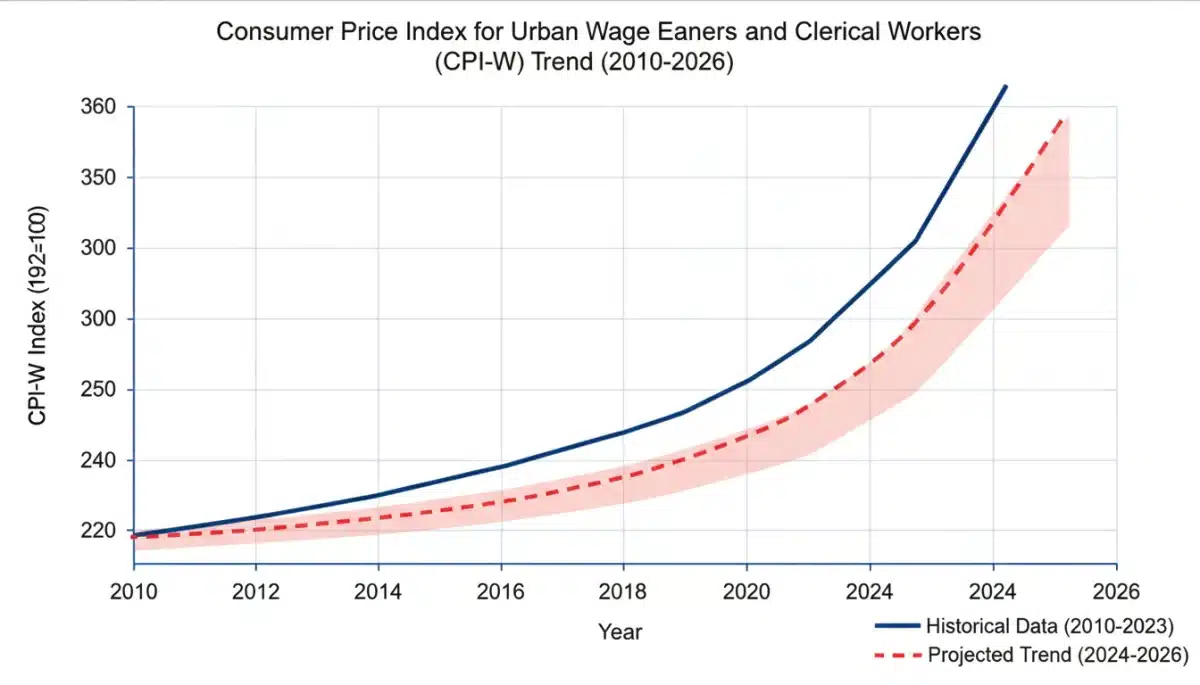

Geopolitical events and global supply chain issues can also exert considerable influence. Disruptions in global trade, international conflicts, or widespread natural disasters can lead to supply shortages and increased costs, which eventually filter down to consumer prices. Therefore, a holistic view of both domestic and international economic landscapes is essential for forecasting the 2026 COLA. The interplay of these factors creates a complex but fascinating picture of future benefit adjustments.
Projections and Forecasts for the 2026 COLA
Forecasting the 2026 Social Security Cost-of-Living Adjustment involves analyzing current economic trends and making informed predictions about future inflation. While it’s impossible to provide an exact figure this far in advance, various organizations and experts offer projections based on their economic models and expectations for the Consumer Price Index for Urban Wage Earners and Clerical Workers (CPI-W). These forecasts provide valuable insights for beneficiaries to consider in their long-term financial planning.
Current economic sentiment suggests a potential moderation in inflation compared to recent peak years, but it’s unlikely to fully revert to pre-pandemic levels. Factors such as ongoing labor market dynamics, evolving supply chain resilience, and the Federal Reserve’s monetary policy decisions will continue to play a role. If inflation cools gradually, we might see a COLA that is more modest than those experienced during periods of high inflation, but still designed to protect purchasing power.
Expert Outlooks and Scenarios
Economists typically develop various scenarios for future COLA adjustments, ranging from optimistic to conservative. These scenarios often hinge on different assumptions about economic growth, energy prices, and global events. For example, a scenario with strong economic growth and stable energy markets might lead to a moderate COLA, while a scenario with renewed inflationary pressures could result in a higher adjustment.
- Moderate Inflation Scenario: CPI-W increases steadily, leading to a COLA in the 2.0-3.0% range.
- Higher Inflation Scenario: Persistent supply chain issues or energy price spikes could push COLA to 3.5%+.
- Low Inflation Scenario: A significant economic slowdown might result in a COLA below 2.0%.
It’s important to remember that these are projections, and the actual 2026 COLA will ultimately depend on the CPI-W data collected during the third quarter of 2025. Beneficiaries should view these forecasts as general guidance rather than definitive figures. Staying informed about economic news and official government reports as they become available will be crucial for understanding the final adjustment. The dynamic nature of the economy means that these projections will be refined as 2025 progresses.
Impact of the 2026 COLA on Your Benefits
The 2026 Social Security Cost-of-Living Adjustment (COLA) directly influences the monthly benefit payments received by millions of Americans. For retirees, disabled individuals, and survivors, this adjustment is more than just a number; it’s a critical component of their income, affecting their ability to cover essential living expenses. Understanding how the COLA translates into actual dollars and its broader financial implications is essential for effective personal financial management.
A positive COLA means an increase in your monthly Social Security check. While even a small percentage increase can seem modest, over the course of a year, it can add up to a significant amount, helping to offset the rising costs of groceries, utilities, and healthcare. Conversely, a low or zero COLA, while rare, would mean no additional financial relief, potentially straining budgets if inflation continues to erode purchasing power. The impact is felt most acutely by those who rely heavily on Social Security as their primary source of income.
Planning for COLA Changes
Beneficiaries should consider the potential COLA when creating or adjusting their annual budgets. While it’s tempting to rely on projections, a conservative approach is often best. Assuming a lower COLA than anticipated can help prevent financial shortfalls. Furthermore, it’s not just the benefit amount that can change; other aspects of your financial life might also be indirectly affected.
- Budget Adjustments: Incorporate the COLA increase into your monthly and annual spending plans.
- Healthcare Costs: Medicare Part B premiums can sometimes rise, offsetting some COLA gains.
- Tax Implications: A higher income from COLA could potentially affect your tax bracket or the taxation of Social Security benefits.
Beyond the immediate increase in benefits, the COLA also has long-term implications for financial planning. It helps preserve the real value of Social Security benefits over time, which is crucial for individuals who may spend decades in retirement. By understanding how the 2026 COLA is likely to affect their specific situation, beneficiaries can make more informed decisions about their savings, investments, and overall financial well-being. It’s a continuous process of adaptation to economic realities.
Strategies for Maximizing Your Social Security Benefits
While the 2026 Social Security Cost-of-Living Adjustment is determined by external economic factors, there are proactive strategies beneficiaries and future retirees can employ to maximize their Social Security benefits. These strategies often involve understanding the rules, making informed decisions about claiming age, and considering how other income sources interact with Social Security. Taking control of what you can influence is key to optimizing your financial future.
One of the most impactful decisions is when to claim your Social Security benefits. While you can start receiving benefits as early as age 62, waiting until your Full Retirement Age (FRA) or even later, up to age 70, can significantly increase your monthly payment. Each year you delay claiming past your FRA, your benefit amount increases by a certain percentage, known as delayed retirement credits. This increase is permanent and applies to all future COLAs, magnifying the long-term benefit.
Key Strategies for Beneficiaries
Beyond claiming age, several other considerations can help optimize your Social Security income. These strategies require careful planning and, in some cases, professional advice to ensure they align with your individual financial situation and goals.
- Delay Claiming: Each year you wait past your FRA (up to age 70) increases your monthly benefit.
- Coordinate with Spouse: Spousal benefits and survivor benefits offer various claiming strategies for married couples.
- Continue Working: Earning more before claiming can increase your average indexed monthly earnings (AIME), which determines your benefit amount.
- Understand Taxation: Know how your other income sources might impact the taxation of your Social Security benefits.
For those still working, increasing your earnings can also positively impact your future benefits, as Social Security calculates benefits based on your 35 highest-earning years. Therefore, working longer or increasing your income during those peak earning years can lead to a higher initial benefit amount, which will then be subject to future COLAs. By implementing these strategies, individuals can enhance their overall financial security and ensure they are getting the most out of their Social Security entitlements, regardless of the specific 2026 COLA.
The Broader Picture: Social Security’s Long-Term Outlook
While focusing on the 2026 Social Security Cost-of-Living Adjustment is important for immediate financial planning, it’s also crucial to consider the broader, long-term outlook for the Social Security system. The program faces ongoing demographic and economic challenges, which periodically lead to discussions about its solvency and potential reforms. Understanding these larger trends provides context for annual adjustments and helps beneficiaries anticipate future changes.
The Social Security program is funded primarily through payroll taxes paid by workers and their employers. As the population ages and the ratio of retirees to workers shifts, concerns about the program’s ability to meet its long-term obligations arise. The annual Trustees’ Report provides detailed projections on the program’s financial health, including when its trust funds are projected to be depleted if no legislative changes are made. These reports often highlight the need for adjustments to ensure the system’s solvency for future generations.
Potential Reforms and Their Implications
Discussions about Social Security reform often involve various proposals aimed at shoring up the program’s finances. These can range from increasing the full retirement age to adjusting the COLA calculation method, or increasing the Social Security tax rate or the amount of earnings subject to taxation. Any significant legislative changes would have far-reaching implications for both current and future beneficiaries.
- Raising the Retirement Age: Could impact when future generations receive full benefits.
- Adjusting COLA Formula: Potentially using a different inflation index, like the Chained CPI, which typically grows slower.
- Increasing Payroll Taxes: Could mean higher contributions from workers and employers.
- Means-Testing Benefits: Adjusting benefits based on a beneficiary’s income level.
The political will and economic conditions will ultimately determine which, if any, reforms are enacted. For beneficiaries, staying informed about these discussions is vital. While the 2026 COLA addresses short-term purchasing power, the long-term stability of Social Security ensures that these benefits will continue to be a cornerstone of retirement security for decades to come. Engaging with these complex issues allows individuals to better understand the future landscape of their entitlements.
| Key Aspect | Description |
|---|---|
| COLA Calculation | Based on CPI-W data from Q3 2025 vs. Q3 2024, designed to counter inflation. |
| Economic Drivers | Inflation (CPI-W), energy prices, housing costs, and global economic stability heavily influence the COLA. |
| Benefit Impact | A positive COLA increases monthly payments, helping maintain purchasing power against rising living costs. |
| Maximizing Benefits | Strategic claiming age, spousal coordination, and continued work can significantly boost lifetime benefits. |
Frequently Asked Questions About the 2026 COLA
The primary purpose of the Social Security Cost-of-Living Adjustment (COLA) is to protect the purchasing power of beneficiaries by increasing their benefits to keep pace with inflation, as measured by the Consumer Price Index for Urban Wage Earners and Clerical Workers (CPI-W).
The 2026 COLA will be calculated by comparing the average CPI-W for the third quarter of 2025 (July, August, September) to the average CPI-W for the third quarter of 2024. The percentage increase determines the adjustment.
No, Social Security benefits cannot decrease due to a COLA. If the CPI-W shows no increase or a decrease, the COLA will be zero, meaning your benefits will remain the same, but they will not be reduced.
The most influential economic factors for the 2026 COLA include the overall inflation rate, particularly as reflected in the CPI-W, energy prices, food costs, and housing market trends. Global economic stability also plays a role.
You can maximize benefits by delaying claiming past your Full Retirement Age (up to age 70), coordinating claiming strategies with a spouse, and working longer to increase your highest 35 earning years, which boosts your base benefit amount.
Conclusion
Understanding The 2026 Social Security Cost-of-Living Adjustment: What to Expect for Your Benefits is a critical step for current and future beneficiaries in navigating their financial landscape. While the precise figure remains subject to future economic data, being informed about the calculation mechanism, influencing factors, and potential impacts allows for more proactive planning. By monitoring economic indicators and employing strategies to maximize your benefits, you can better prepare for the financial realities of retirement and ensure your Social Security income continues to support your needs. The COLA, while an annual adjustment, is a vital piece of a much larger financial puzzle, underscoring the importance of continuous awareness and thoughtful preparation.