6-Week Study Plan for Standardized Tests: High School Success

Anúncios
This comprehensive 6-week study plan offers US high schoolers an effective, structured approach to mastering standardized tests, ensuring thorough preparation and boosting confidence for optimal scores.
Anúncios
For many US high schoolers, the thought of standardized tests like the SAT or ACT can be daunting. These exams play a significant role in college admissions, making effective preparation crucial. This article provides a detailed guide on preparing for standardized tests, offering a practical 6-week study plan designed to maximize your potential and alleviate test-day anxiety.
Anúncios
Understanding Standardized Tests and Their Importance
Before diving into a study plan, it’s essential to grasp what standardized tests entail and why they matter. These exams are designed to assess a student’s readiness for college-level work, covering subjects like reading, writing, and mathematics. While some colleges have adopted test-optional policies, strong scores can still significantly enhance an application, especially for competitive programs or scholarship opportunities.
Understanding the structure of tests like the SAT and ACT is the first step in effective preparation. Each test has a unique format, scoring system, and question types. Familiarizing yourself with these nuances will allow you to tailor your study efforts more precisely, focusing on areas where you need the most improvement.
SAT vs. ACT: Which One Should You Take?
Many students wonder whether to take the SAT or ACT. Both are widely accepted, but they differ in content and style. The SAT tends to focus more on reasoning and problem-solving, while the ACT is often seen as more direct, testing knowledge acquired in high school coursework. It’s often recommended to take a diagnostic test for both to see which format better suits your strengths.
- SAT Focus: Evidence-based reading and writing, math (with and without calculator sections), optional essay.
- ACT Focus: English, math, reading, science, optional writing test.
- Time Management: The ACT generally has more questions per section, requiring faster pacing.
- Content: ACT includes a science section, which the SAT does not.
Ultimately, the choice depends on your individual strengths and preferences. Some students find one test’s structure more intuitive than the other. Dedicating time early on to understand these differences can save valuable study time later.
Week 1: Assessment and Goal Setting
The first week of your standardized test preparation journey is crucial for laying a solid foundation. This stage involves understanding your current performance level and setting realistic, achievable goals. Without a clear starting point and destination, your study efforts might lack direction and efficiency.
Begin by taking a full-length diagnostic practice test for the exam you’ve chosen (SAT or ACT). Simulate test-day conditions as closely as possible: find a quiet space, adhere to time limits, and avoid interruptions. This initial assessment will provide invaluable insights into your strengths and weaknesses across all sections of the test.
Analyzing Your Diagnostic Test Results
Once you’ve completed the practice test, meticulously review your answers. Don’t just look at the score; understand why you got certain questions wrong. Was it a knowledge gap? A misunderstanding of the question? Or perhaps a time management issue? Detailed error analysis is a cornerstone of effective study.
- Identify Weak Areas: Pinpoint specific topics or question types that consistently cause trouble.
- Review Explanations: Understand the correct answers and the reasoning behind them.
- Track Time: Note sections where you ran out of time or spent too long on questions.
Based on this analysis, set specific, measurable, achievable, relevant, and time-bound (SMART) goals for your target score. Break down your overall score goal into section-specific targets. This makes the daunting task of improving your score feel more manageable and provides clear milestones to work towards during the subsequent weeks.
Week 2: Content Review and Strategy Development
With a clear understanding of your strengths and weaknesses, Week 2 shifts focus to targeted content review and the development of effective test-taking strategies. This phase is about filling knowledge gaps and equipping yourself with the mental tools needed to approach different question types confidently.
Prioritize the areas identified as weak during your diagnostic assessment. If math is a challenge, dedicate more time to reviewing algebra, geometry, or statistics concepts. For reading, focus on comprehension techniques, vocabulary building, or identifying main ideas. Utilize textbooks, online resources, and study guides to reinforce these foundational skills.
Developing Test-Taking Strategies
Beyond content knowledge, standardized tests also assess your ability to apply strategies under pressure. This week, start practicing specific techniques for each section. For example, in the reading section, explore strategies like skimming for main ideas, identifying keywords, or eliminating obviously wrong answers. For math, learn to recognize common problem types and the most efficient methods for solving them.
- Pacing: Practice answering questions within strict time limits.
- Process of Elimination: Systematically rule out incorrect answer choices.
- Guessing Strategy: Understand when and how to guess effectively (on some tests, there’s no penalty for wrong answers).
- Question Triage: Learn to identify and prioritize easier questions first.
Experiment with different strategies during your practice sessions to discover what works best for you. The goal is to build a repertoire of techniques that you can confidently deploy on test day, reducing hesitation and maximizing your efficiency. Consistency in applying these strategies will lead to greater familiarity and improved performance.
Week 3-4: Intensive Practice and Timed Drills
Weeks 3 and 4 are dedicated to intensive practice, applying the content knowledge and strategies you’ve developed. This is where consistent, timed drills become your best friend. The more you practice under simulated test conditions, the more comfortable and confident you’ll become with the pace and pressure of the actual exam.
Focus on completing full sections of practice tests, adhering strictly to the time limits. This helps build stamina and improves your ability to maintain focus over an extended period. After each timed section, conduct another thorough review of your answers, paying close attention to both correct and incorrect responses. Understand why you got a question right, not just that you did, to reinforce effective strategies.
Utilizing Practice Tests Effectively
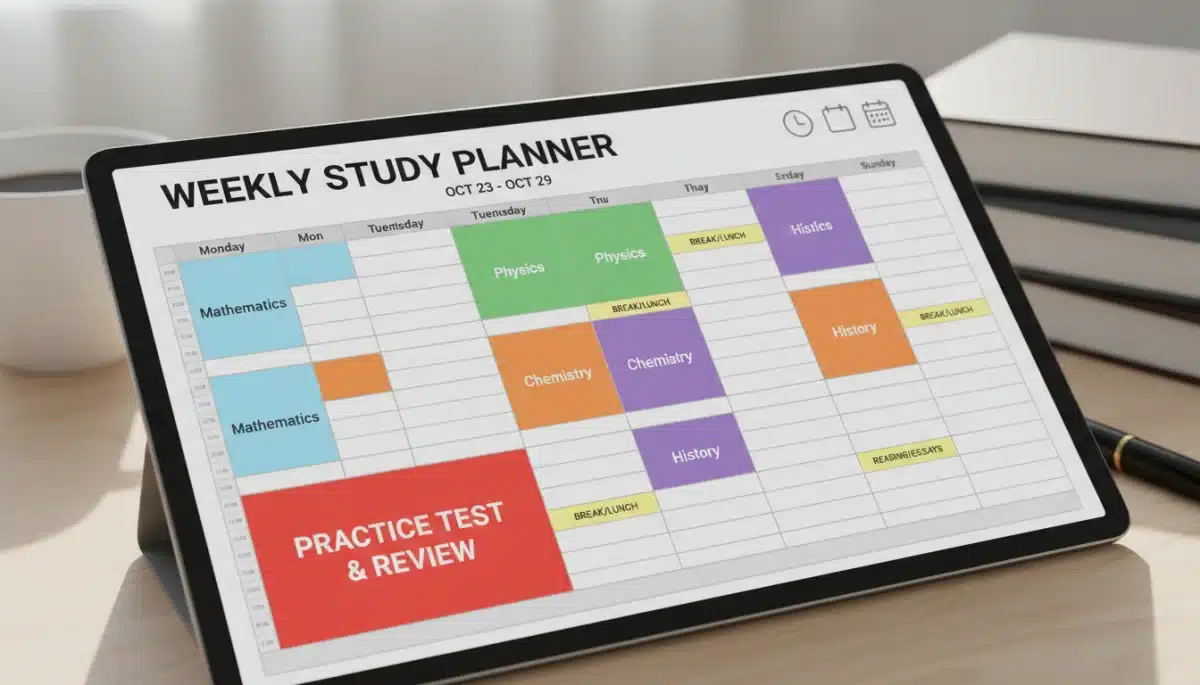
Don’t just take practice tests; dissect them. Analyze patterns in your errors. Are you still struggling with a particular math concept? Or consistently misinterpreting certain types of reading passages? Use these insights to fine-tune your content review and strategy application. Consider dedicating specific days to full-length practice tests, followed by a day of detailed review and targeted remediation.
- Official Practice Tests: Prioritize tests released by the College Board (for SAT) or ACT, Inc.
- Review Every Question: Even for correct answers, consider if there was a more efficient way to solve it.
- Track Progress: Keep a log of your scores and error types to visualize improvement.
This period is also an excellent time to identify any persistent weaknesses that might benefit from additional resources, such as tutoring or specific online modules. Don’t hesitate to seek extra help if you find yourself continually stuck on certain topics. The intensive practice of these weeks is about solidifying your understanding and refining your approach to every question.
Week 5: Full-Length Mock Tests and Endurance Building
As you enter Week 5, the emphasis shifts to simulating the full test-day experience. This involves taking multiple full-length mock tests under conditions as close to the real thing as possible. This stage is critical for building the mental and physical endurance required to perform optimally on test day.
Schedule your mock tests on a weekend, mimicking the actual test day schedule. Wake up at the same time, eat a similar breakfast, and take the test in a quiet environment without distractions. Complete all sections, including the optional essay if you plan to take it, and adhere strictly to all time limits and break schedules. The goal is to make the actual test day feel familiar, reducing anxiety and unexpected challenges.
Refining Pacing and Stamina
After each mock test, perform a comprehensive review. Analyze your pacing in each section. Did you run out of time? Did you finish too early, potentially rushing through questions? Identify areas where you can improve your time management. This is also the time to refine your break strategies – how you use your short breaks to recharge and refocus.
- Simulate Breaks: Practice using the exact break times provided on the actual test.
- Mental Toughness: Develop strategies to maintain focus and combat fatigue during long sections.
- Nutrition and Hydration: Experiment with snacks and drinks that sustain your energy without causing discomfort.
Week 5 is not just about academic preparation; it’s about holistic preparation. Ensure you’re also paying attention to your sleep schedule, nutrition, and stress management techniques. By consistently practicing under realistic conditions, you’ll build the stamina and mental resilience necessary to tackle the standardized test with confidence.
Week 6: Review, Relaxation, and Final Preparations
The final week before your standardized test should be less about cramming new information and more about solidifying existing knowledge, managing stress, and making final logistical preparations. Overloading your brain in the last few days can lead to burnout and decreased performance.
Instead of intense new learning, focus on reviewing key concepts, formulas, and strategies that you’ve already covered. Glance through your notes, revisit challenging practice questions you’ve previously marked, and do light, untimed practice sets to keep your mind engaged without undue pressure. Trust the preparation you’ve already put in over the past five weeks.
Test Day Logistics and Mental Wellness
This week is also crucial for handling all the practical aspects of test day. Confirm the test center location, plan your route, and gather all necessary items: identification, admission ticket, pencils, an approved calculator, and snacks/water for breaks. Eliminate any potential last-minute surprises.
- Gather Essentials: Pack your bag the night before.
- Confirm Details: Double-check test time and location.
- Prioritize Sleep: Aim for 7-9 hours of sleep each night, especially the night before the test.
- Relaxation Techniques: Practice deep breathing or mindfulness to calm nerves.
Most importantly, prioritize your mental well-being. Engage in relaxing activities, spend time with loved ones, and avoid anything that adds unnecessary stress. A calm and well-rested mind is your most powerful tool on test day. Trust your hard work, stay positive, and approach the exam with a confident and clear head. You’ve earned it.
| Key Study Phase | Primary Focus |
|---|---|
| Week 1: Assessment | Diagnostic test, error analysis, goal setting. |
| Week 2: Content & Strategy | Targeted review of weak areas, learning test-taking strategies. |
| Weeks 3-4: Intensive Practice | Timed drills, section practice, in-depth error review. |
| Week 5: Mock Tests | Full-length simulations, endurance building, pacing refinement. |
Frequently Asked Questions About Standardized Test Prep
Ideally, dedicate 1-2 hours daily to preparation, broken into focused sessions. Consistency is more effective than sporadic long study blocks. Adjust this based on your personal schedule and the intensity of your academic workload, ensuring you don’t burn out before the actual test.
A balanced approach is best. Dedicate more time to weak areas to bring them up to par, but also practice strong areas to maintain proficiency and ensure you don’t lose easy points. This strategy maximizes overall score potential by addressing all aspects of the test.
Official practice tests from College Board (SAT) or ACT, Inc. are invaluable. Additionally, reputable test prep books, online platforms like Khan Academy, and potentially a tutor for specific challenges can significantly enhance your study efforts. Choose resources that align with your learning style.
The importance of the essay section varies. Many colleges no longer require or consider it. Check the specific requirements of the universities you are applying to. If it’s optional for your target schools, consider if the extra prep time is worthwhile compared to focusing on multiple-choice sections.
If scores plateau, re-evaluate your study methods. Are you thoroughly reviewing mistakes? Are you using effective strategies? Consider seeking feedback from a teacher or tutor. Sometimes a fresh perspective or a different approach to a difficult concept can unlock significant improvement. Persistence is key.
Conclusion
Preparing for standardized tests doesn’t have to be an overwhelming ordeal. By following a structured and disciplined 6-week study plan, US high schoolers can systematically address their weaknesses, hone their strengths, and build the confidence needed to excel. Remember, success on these exams is not solely about intelligence, but also about effective strategy, consistent effort, and thoughtful preparation. Embrace this journey with a positive mindset, and you’ll be well on your way to achieving your academic goals and opening doors to your desired higher education opportunities. Your dedication today will pave the way for a brighter tomorrow.