U.S. Dollar Index: 10% Shift Impact on International Holdings 2026

Anúncios
A 10% shift in the U.S. Dollar Index by 2026 could significantly alter the value of international investments, demanding careful portfolio adjustments and strategic financial planning.
Understanding The Current State of the U.S. Dollar Index: What a 10% Shift Means for Your International Holdings in 2026 is not merely an academic exercise; it’s a critical component of prudent financial planning. As we navigate an increasingly interconnected global economy, currency fluctuations can profoundly impact the real returns on your investments abroad. How might such a significant movement in the dollar affect your wealth?
Anúncios
Understanding the U.S. Dollar Index (DXY)
The U.S. Dollar Index, often referred to as DXY, serves as a vital benchmark for assessing the dollar’s strength against a basket of six major world currencies. These include the Euro (EUR), Japanese Yen (JPY), British Pound (GBP), Canadian Dollar (CAD), Swedish Krona (SEK), and Swiss Franc (CHF). Its value reflects the weighted average of the dollar’s exchange rates relative to these currencies, offering a comprehensive snapshot of its international standing.
Anúncios
A higher DXY value indicates a stronger dollar, meaning it takes fewer dollars to buy a given amount of foreign currency or foreign assets. Conversely, a lower DXY suggests a weaker dollar. This index is not static; it’s influenced by a myriad of factors ranging from interest rate differentials to geopolitical events, making its movements a constant subject of analysis for investors and economists alike.
Key Components and Weighting
The DXY’s composition is a crucial aspect to understand, as certain currencies hold more sway in its calculation. The euro, for instance, has the largest weighting, reflecting the significant economic ties between the U.S. and the Eurozone. This weighting ensures that the index provides a relevant measure of the dollar’s global purchasing power.
- Euro (EUR): Approximately 57.6%
- Japanese Yen (JPY): Approximately 13.6%
- British Pound (GBP): Approximately 11.9%
- Canadian Dollar (CAD): Approximately 9.1%
- Swedish Krona (SEK): Approximately 4.2%
- Swiss Franc (CHF): Approximately 3.6%
The DXY’s movements are not just abstract numbers; they translate directly into real-world implications for trade, investment, and individual purchasing power. Monitoring this index provides crucial insights into potential shifts in global economic dynamics and their subsequent impact on your financial portfolio.
In essence, the U.S. Dollar Index is more than just a number; it’s a barometer of global economic health and a key indicator for anyone with international financial interests. Its composition and the factors influencing it are fundamental to forecasting its future trajectory and preparing for its potential impact.
The Mechanics of a 10% DXY Shift
A 10% shift in the U.S. Dollar Index, whether upward or downward, represents a substantial movement with far-reaching consequences across global financial markets. Such a change is not merely a statistical anomaly but a reflection of significant underlying economic forces at play. Understanding the mechanics behind such a shift is crucial for appreciating its potential impact.
When the DXY strengthens by 10%, it implies that the U.S. dollar has appreciated by that margin against the weighted average of its peer currencies. This could be driven by factors such as higher U.S. interest rates relative to other developed nations, strong U.S. economic growth attracting capital, or a flight to safety during global economic uncertainty. Conversely, a 10% weakening of the DXY would suggest the opposite: lower U.S. interest rates, slower growth, or a loss of confidence in the U.S. economy.
Factors Driving Significant Currency Movements
Several key macroeconomic factors typically underpin a shift of this magnitude in the DXY. These drivers are often interconnected, creating a complex web of influences that can be challenging to predict with absolute certainty.
- Interest Rate Differentials: Higher interest rates in the U.S. compared to other major economies make dollar-denominated assets more attractive, drawing in foreign capital and strengthening the dollar.
- Economic Growth Outlook: A robust U.S. economy, characterized by strong GDP growth and low unemployment, tends to attract international investors, boosting demand for the dollar.
- Geopolitical Stability: During times of global crisis or uncertainty, the U.S. dollar often acts as a safe-haven currency, leading to increased demand and appreciation.
- Monetary Policy Divergence: Different approaches by central banks (Federal Reserve versus European Central Bank, Bank of Japan, etc.) can create significant currency movements.
The interplay of these factors determines the trajectory of the DXY. For instance, if the Federal Reserve adopts a more hawkish stance while other central banks remain dovish, a strengthening dollar is a likely outcome. Conversely, if the U.S. economy faces headwinds while others recover strongly, a weakening dollar could ensue.
Ultimately, a 10% shift in the DXY is a powerful signal. It reflects a significant re-evaluation of the U.S. dollar’s value in the global financial landscape, with direct implications for international trade, investment flows, and the profitability of multinational corporations.
Impact on International Stock Holdings
For investors holding international stocks, a 10% shift in the U.S. Dollar Index can have a profound impact on their portfolio’s performance. This effect is twofold, influencing both the reported earnings of foreign companies and the currency conversion rate when repatriating profits back to U.S. dollars.
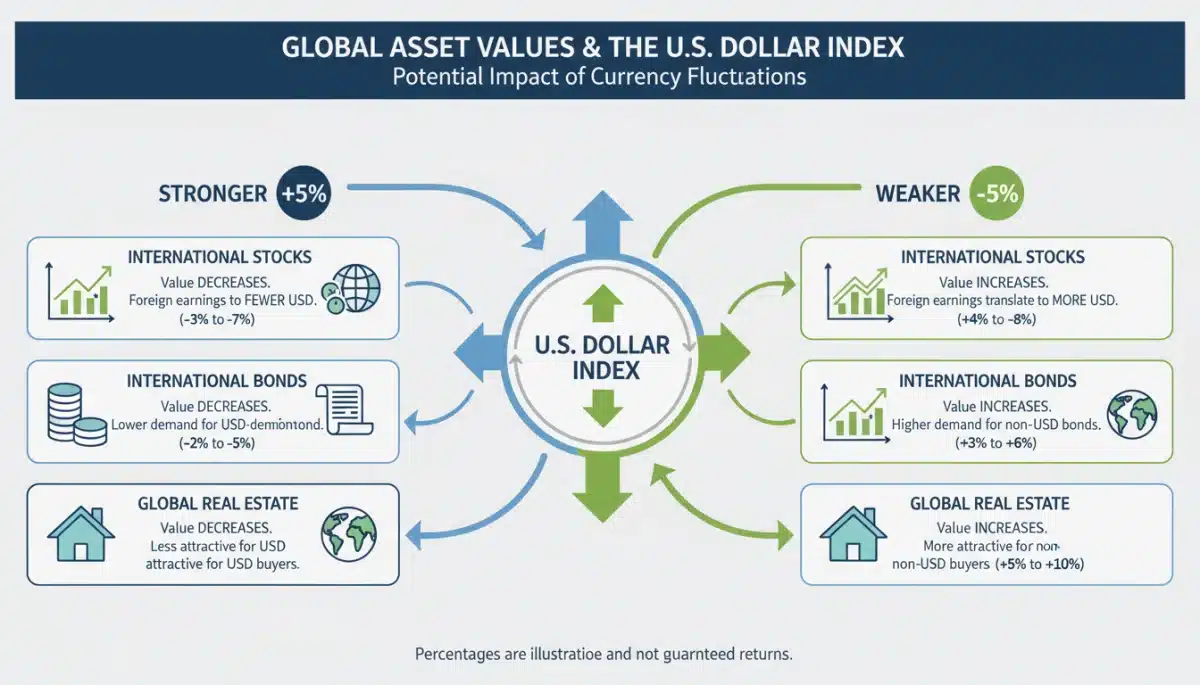
If the DXY strengthens by 10%, it means foreign currencies are now worth less in dollar terms. Consequently, the dollar value of your international stock holdings denominated in those foreign currencies will decrease, even if the underlying stock price in its local currency remains unchanged. This currency translation effect can erode a significant portion of your gains or amplify your losses.
Conversely, a 10% weakening of the DXY would have the opposite effect. Foreign currencies would be worth more in dollar terms, boosting the dollar value of your international stock investments. This can provide an unexpected tailwind to your returns, making foreign markets appear even more attractive.
Currency Translation and Repatriation Risks
The primary mechanism through which DXY shifts affect international stock holdings is currency translation. When a U.S. investor holds shares in a company listed on a foreign exchange, the value of that investment is initially denominated in the local currency. When reporting performance in U.S. dollars, this local currency value must be converted.
Consider a scenario where you invest in a European company. If the Euro depreciates by 10% against the dollar (implying a stronger DXY), your investment, when converted back to dollars, will be worth 10% less, even if the company’s stock price in Euros remained constant. This is a critical risk factor for U.S. investors with international exposure.
Furthermore, the earnings of multinational corporations can also be affected. U.S. companies with significant international operations will see their foreign earnings translate into fewer dollars if the DXY strengthens, potentially impacting their profitability and stock price. Similarly, foreign companies exporting to the U.S. might find their products more expensive if their local currency weakens against the dollar, affecting their competitiveness.
Therefore, understanding the DXY’s potential movements is essential for managing the currency risk associated with international stock investments. Investors often employ hedging strategies, such as currency forward contracts or currency-hedged ETFs, to mitigate these risks and protect their dollar-denominated returns.
Impact on International Bond Holdings
International bond holdings, often perceived as a safer asset class, are not immune to the volatility introduced by a 10% shift in the U.S. Dollar Index. In fact, currency fluctuations can significantly impact the total return an investor realizes from their foreign bond portfolio, affecting both the principal value and the interest payments received.
When the DXY strengthens by 10%, foreign bonds denominated in local currencies will see their dollar value decrease. This is because the income streams from coupons, and the principal repayment at maturity, will be converted back into fewer U.S. dollars. This can offset, or even negate, any positive yield generated by the bond itself.
Conversely, a 10% weakening of the DXY would enhance the dollar value of foreign bond holdings. Both the coupon payments and the principal would convert into more U.S. dollars, boosting the overall return for the U.S. investor. This currency appreciation can make foreign bonds particularly attractive during periods of dollar weakness.
Interest Rates and Yield Differentials
The relationship between interest rates and currency movements is particularly pronounced in the bond market. If U.S. interest rates rise relative to those in other countries, it makes dollar-denominated bonds more attractive, leading to increased demand for the dollar and a strengthening DXY. This can create a headwind for investors holding foreign bonds, as their local currency returns might be diminished when converted to a stronger dollar.
- Stronger DXY: Reduces the dollar-denominated value of foreign bond principal and coupon payments.
- Weaker DXY: Increases the dollar-denominated value of foreign bond principal and coupon payments.
- Yield Differentials: U.S. bonds may become more appealing if U.S. yields are significantly higher than foreign yields, drawing capital towards the dollar.
Moreover, the creditworthiness of the issuing country also plays a role. Bonds from emerging markets, while often offering higher yields, typically carry greater currency risk due to the potential for more volatile exchange rate movements against the dollar. A significant DXY shift can exacerbate these risks, making careful due diligence essential.
Ultimately, investing in international bonds requires a keen awareness of currency risk. A 10% DXY shift can dramatically alter the profitability of these investments, underscoring the need for a comprehensive understanding of global economic and monetary policy trends.
Commodities and Real Estate Implications
Beyond traditional stocks and bonds, a 10% shift in the U.S. Dollar Index also has significant implications for international commodity holdings and real estate investments. These asset classes, while distinct, share a common sensitivity to currency movements, particularly concerning the global pricing of commodities and the local purchasing power for real estate.
Commodities, such as oil, gold, and agricultural products, are predominantly priced in U.S. dollars on international markets. Therefore, a stronger DXY (meaning a stronger dollar) typically makes these commodities more expensive for buyers using other currencies. This can lead to decreased demand and, consequently, lower dollar-denominated commodity prices. Conversely, a weaker DXY makes commodities cheaper for international buyers, potentially driving up demand and prices.
For international real estate, the impact is primarily on the cost of acquisition and the value of rental income. A stronger DXY means that U.S. investors can purchase foreign properties at a lower dollar cost, as their dollars buy more of the local currency. However, if they are receiving rental income in the local currency, that income will convert to fewer dollars, reducing their effective yield.
Global Pricing and Local Market Dynamics
The global pricing mechanism for commodities means that a strong dollar can create headwinds for commodity producers and investors. If the dollar strengthens by 10%, a barrel of oil priced at $80 will effectively cost non-dollar users 10% more in their local currency, even if the dollar price remains constant. This can dampen global economic activity and demand for raw materials.
In the real estate sector, a weaker dollar can attract foreign buyers to the U.S. market, as their currencies have greater purchasing power. Conversely, a stronger dollar might make U.S. real estate less appealing to foreign investors but could make foreign real estate more attractive to U.S. buyers. The local market dynamics, including interest rates and economic growth in the specific region, also play a crucial role.
- Commodity Price Sensitivity: Stronger dollar typically leads to lower dollar-denominated commodity prices due to reduced international purchasing power.
- Real Estate Acquisition: A stronger dollar allows U.S. investors to buy more foreign real estate for the same dollar amount.
- Rental Income Conversion: Rental income from foreign properties converts to fewer dollars when the DXY strengthens.
Understanding these dynamics is vital for investors with exposure to these asset classes. A 10% DXY shift can significantly alter the profitability of both commodity trades and international real estate ventures, necessitating a nuanced approach to risk management and portfolio allocation.
Strategic Portfolio Adjustments for 2026
Given the potential for a 10% shift in the U.S. Dollar Index by 2026, proactive strategic portfolio adjustments are not just advisable but essential for protecting and enhancing international holdings. Investors must consider various strategies to mitigate currency risk and capitalize on potential opportunities arising from such a significant currency movement.
One primary strategy is diversification. Spreading investments across various countries and currencies can naturally hedge against adverse movements in any single currency. However, even within a diversified international portfolio, a strong DXY shift can still have a broad impact, necessitating more targeted approaches.
Hedging Strategies and Diversification
Currency hedging is a sophisticated technique used to minimize exposure to currency fluctuations. This can involve using financial instruments like forward contracts, options, or currency-hedged exchange-traded funds (ETFs). For example, if you anticipate a stronger dollar, you might consider hedging your foreign equity exposure to lock in current exchange rates. This ensures that the returns on your foreign assets are primarily driven by their local performance, rather than currency movements.
- Currency Forward Contracts: Agreeing to exchange a set amount of currency at a predetermined rate on a future date.
- Currency Options: Providing the right, but not the obligation, to exchange currency at a specific rate.
- Currency-Hedged ETFs: Funds that automatically implement hedging strategies to neutralize currency fluctuations.
Another approach is to favor investments in regions or sectors that are less sensitive to dollar strength. For instance, companies with significant domestic sales in their local currency might be less affected than those heavily reliant on exports to the U.S. or other dollar-pegged economies. Furthermore, considering investments in countries with strong economic fundamentals and sound fiscal policies can provide a buffer against currency volatility.
For real estate investors, focusing on properties in countries with robust domestic demand and less reliance on international transactions can be a wise move. Similarly, for commodity investors, understanding the elasticity of demand and supply in different markets can help in making informed decisions.
Ultimately, the key to navigating a potential 10% DXY shift lies in a well-thought-out strategy that combines broad diversification with targeted hedging and a deep understanding of macroeconomic trends. Regular review and adjustment of your portfolio will be crucial as 2026 approaches.
Forecasting the DXY: What to Watch for in 2026
Forecasting the future trajectory of the U.S. Dollar Index for 2026 involves scrutinizing a complex interplay of economic, monetary, and geopolitical factors. While precise predictions are inherently challenging, understanding the key indicators can help investors anticipate potential shifts and prepare accordingly. The global economic landscape is constantly evolving, and several critical elements will likely dictate the dollar’s strength or weakness.
One of the most significant factors to monitor is the Federal Reserve’s monetary policy. Interest rate decisions, quantitative easing or tightening measures, and forward guidance on inflation and employment will all profoundly influence the dollar’s appeal. Divergence in monetary policy between the Fed and other major central banks, such as the European Central Bank or the Bank of Japan, will be particularly impactful.
Key Economic Indicators and Geopolitical Events
Beyond monetary policy, a range of economic indicators will provide crucial insights into the health of the U.S. economy relative to its peers. Strong U.S. GDP growth, low unemployment rates, and contained inflation typically support a stronger dollar, as they signal a robust economy attracting capital inflows. Conversely, signs of economic weakness could lead to dollar depreciation.
- Interest Rate Decisions: Federal Reserve’s stance on rates relative to other central banks.
- Economic Growth (GDP): Strength of U.S. economic expansion compared to major trading partners.
- Inflation Data: U.S. inflation trends and the Fed’s response to maintain price stability.
- Geopolitical Developments: Major global events, conflicts, or political instability that could drive safe-haven flows into or out of the dollar.
- Trade Balances: U.S. trade deficits or surpluses and their impact on dollar demand.
Geopolitical events also play a critical role. Global crises, political instability in major economic blocs, or significant shifts in international trade relations can trigger flight-to-safety dynamics, often benefiting the U.S. dollar. Conversely, a period of sustained global stability and cooperation could reduce the dollar’s safe-haven appeal.
Moreover, the fiscal health of the U.S., including government debt levels and budget deficits, will continue to be a long-term consideration for dollar strength. While not typically a short-term driver of 10% shifts, sustained fiscal imbalances can erode confidence over time.
By carefully monitoring these multifaceted indicators, investors can develop a more informed perspective on the likely direction of the U.S. Dollar Index by 2026, enabling them to make more strategic decisions regarding their international holdings.
| Key Impact Area | Brief Description of 10% DXY Shift |
|---|---|
| International Stocks | Stronger DXY reduces dollar value of foreign equity; weaker DXY increases it, affecting returns. |
| International Bonds | A 10% DXY shift impacts dollar-denominated principal and coupon payments, affecting overall yield. |
| Commodities | Stronger DXY typically makes dollar-priced commodities more expensive for foreign buyers, reducing demand. |
| Real Estate | Stronger DXY means more purchasing power for U.S. investors abroad, but lower converted rental income. |
Frequently Asked Questions About the U.S. Dollar Index
The U.S. Dollar Index (DXY) measures the value of the U.S. dollar relative to a basket of six major world currencies: the Euro, Japanese Yen, British Pound, Canadian Dollar, Swedish Krona, and Swiss Franc. It acts as a benchmark for the dollar’s international strength.
A stronger DXY means foreign currencies are worth less in dollar terms. This reduces the dollar-denominated value of international stocks, bonds, and real estate, impacting U.S. investors’ returns even if local asset prices remain stable.
Significant DXY shifts are driven by factors like interest rate differentials, U.S. economic growth, monetary policy divergence, and global geopolitical events. A 10% move reflects substantial changes in these underlying economic forces.
Investors can mitigate currency risk through diversification across various currencies and regions. Additionally, employing hedging strategies like currency forward contracts, options, or using currency-hedged ETFs can help protect against adverse DXY movements.
To forecast DXY movements, monitor the Federal Reserve’s monetary policy, U.S. economic growth (GDP, employment), inflation trends, and significant geopolitical developments. These factors collectively influence the dollar’s global standing.
Conclusion
The prospect of a 10% shift in the U.S. Dollar Index by 2026 presents both challenges and opportunities for investors with international holdings. Understanding the intricate dynamics of currency markets, from the DXY’s composition to the macroeconomic forces that drive its movements, is paramount. Whether it strengthens or weakens, such a significant change will inevitably reprice international stocks, bonds, commodities, and real estate in dollar terms. Proactive portfolio adjustments, including strategic diversification and targeted hedging, are not merely advisable but essential. By staying informed on key economic indicators and geopolitical trends, investors can better position their portfolios to navigate currency volatility, safeguard their wealth, and potentially capitalize on the evolving global financial landscape as we approach 2026.